SANTO DOMINGO.- The Ministry of Public Works and Communications (MOPC) announced this Monday that starting April 26th, it will implement a comprehensive solid waste collection program on highways and roads, called “My Clean Highway, Everyone’s Commitment!”
This program will be coordinated with the Dominican Municipal League and the Dominican Federations of Municipalities (FEDOMU) and Municipal Districts (FEDODIM).
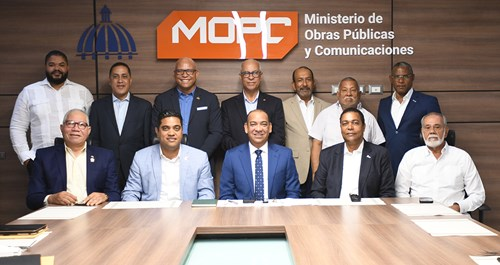
During a meeting held at the MOPC headquarters, led by Minister Deligne Ascención and the president of the League, Víctor D'Aza, it was reported that the project to be carried out includes a pilot plan that starts on the 6 de Noviembre highway to San Cristóbal, Las Américas to Boca Chica, and the Duarte to the municipality of Pedro Brand.
Monday's meeting will be followed by another at a League meeting on the 19th of this month, in which Ascención will explain the program to the mayors and directors of municipal districts whose territories include the banks of the 6 de Noviembre, Duarte and Las Américas highways.
Furthermore, other mayors and district board directors will be joining later.
The initiative aims to clean, beautify, care for the environment and preserve the maintenance of the three main roads through which most of the country's cargo, passenger and tourist traffic currently moves.
Victor D'Aza, Kelvin Cruz and Pedro Richardson, presidents of LMD, Fedomu and Fedodim, respectively, listened to the general guidelines of the program from Minister Ascención, welcoming it with enthusiasm and expressing their willingness to participate with a responsibility that also corresponds to them.
Ascención and the municipal authorities emphasized the importance of citizen empowerment in the initiative, in which the media and citizens with a presence on social networks will play a fundamental role.
He said that this program constitutes the first step of a journey that must be prolonged because it is about changing a culture that unfortunately has been growing in our country over the years due to a lack of urban planning by citizens.
“You see a high-end vehicle, just like with any other vehicle, there are people who take a small bottle of water and throw the bottle out, the same with plastic cups,” he said.
He said that if the institutions involved do not work together, the effort will be wasted. He noted that the project in progress is a fundamental support for tourism, since highways and roads are the face the country presents to visitors.
It is also noted that there is a practice of dumping garbage around the Duarte and 6 de Noviembre highways, due to the proximity of large human populations, and that the largest accumulations of waste occur on the routes to the South region, with the exception of Baní, where there are more controls.
He said that an amount equivalent to 10, 12 or 15 tons is collected daily in 55-gallon black bags.
He argued that what the various institutions involved are proposing "should be a campaign with a strong institutional component," and that it seeks to change the culture of the population, in addition to raising awareness about the negative consequences of littering.
He reported that in areas such as kilometers 15 and 16 of the Duarte highway, near the entrance to Los Alcarrizos, there is a practically unsanitary situation due to the amount of accumulated waste.
The program begins with a pilot plan on the 6 de Noviembre highway, scheduled for the 26th of this month, and will later be transferred to the Duarte and Las Américas highways.
Ascención reported that the program will also be coordinated with the owners of businesses and lots located on the fronts of the highways, with passenger transport companies and truckers, as well as with the neighborhood associations adjacent to the roads.
Also, with state institutions, such as the Ministry of Environment, the Military and Police Commission, RedVial, among others
The president of the LMD, Víctor D'Aza, promised that the institution will join the project, while pointing out that mayors tend to focus on cleaning up their own cities, and that the cities themselves look clean, but that the highways or intermunicipal roads are dirty because they believe it is not their responsibility to clean them.
Kelvin Cruz, president of Fedomu and mayor of the municipality of La Vega, while congratulating the initiative, said that the project will be very significant. He suggested that a joint operation be carried out by the participating institutions to collect all plastic, linen, and other waste.
Pedro Richardson, president of Fedodim, suggested that in addition to cleaning the highways of discarded waste, the planting of ornamental plants and trees, such as bougainvillea and yellow oak, should also be included.
Minister Ascención was accompanied by Vice Ministers Luis Bastardo, of Road Maintenance; Roberto Herrera, of Technical Supervision and Inspection; Ángel Tejeda, of Technical Planning and Regulation; and Rafael Espinal, Chief of Staff.
Also, Élido Pérez, municipal advisor to the Executive Branch, Fausto Ruiz, former mayor of La Vega, and Nelson Marte and Andrés Martínez.